
As aesthetic medicine has evolved, the focus has shifted beyond simply filling lines and wrinkles. Patients are now looking for treatments that work with the body’s natural regenerative processes, helping to improve skin quality, restore facial support and encourage healthier collagen production over time.
This growing interest has brought collagen stimulators such as Radiesse and Sculptra into the spotlight. Rather than simply replacing lost volume, these treatments are designed to stimulate your own collagen, supporting the skin from within and delivering gradual, natural-looking improvements. Although they share this common goal, they work in different ways and each has its own strengths.
At Youtopia Medical, we often find that patients arrive having researched both treatments online, but many are unsure which would be most appropriate for their concerns. In reality, there is no single collagen stimulator that is right for everyone. The best choice depends on factors such as your skin quality, facial anatomy, degree of collagen loss and the type of result you hope to achieve.
In this guide, we’ll explain the difference between Radiesse and Sculptra, how each treatment works, who they are best suited to and the factors experienced practitioners consider when deciding which collagen stimulator is likely to deliver the most natural and effective outcome.
Why Does Collagen Loss Change the Face?
Collagen is the most abundant structural protein in the body and is responsible for much of the skin’s strength, firmness and resilience. Alongside elastin and hyaluronic acid, it forms the supportive framework that keeps the skin smooth and the facial tissues well supported.
From our mid-twenties onwards, collagen production naturally begins to decline. While this process is gradual, its effects become more noticeable over time as the skin becomes thinner and less able to resist gravity.
Collagen loss contributes to many of the changes commonly associated with facial ageing, including:
- Reduced skin firmness
- Fine lines and wrinkles
- Early skin laxity
- Less defined jawlines
- Hollowing through the cheeks and temples
- Crepey skin
- Reduced elasticity
These changes rarely happen in isolation. At the same time, we also lose facial fat, the underlying ligaments gradually weaken and even the facial bones remodel as we age. This is why two people of the same age can look very different and why one treatment is rarely the answer to every concern.
Understanding exactly what has changed beneath the skin is often far more important than deciding between two products.
What Are Collagen Stimulators?
Unlike traditional dermal fillers, collagen stimulators are designed to encourage the body to repair and regenerate its own tissues.
Rather than simply occupying space beneath the skin, they trigger a controlled biological response that stimulates fibroblasts, the cells responsible for producing collagen.
As new collagen develops, the skin gradually becomes stronger and better supported. Depending on the treatment chosen, patients may also notice improvements in skin firmness, elasticity and overall texture.
Because this process relies on the body’s natural healing response, results usually develop gradually over several weeks or months rather than appearing instantly.
This makes collagen stimulators particularly attractive for patients who want natural-looking rejuvenation that continues to improve over time.
How Does Radiesse Work?
Radiesse is a collagen stimulator made from calcium hydroxylapatite (CaHA), a material that has been used safely in medicine for many years.
The treatment contains tiny calcium hydroxylapatite microspheres suspended within a smooth gel carrier. These two components work together in different ways.
Immediately after treatment, the gel provides structural support beneath the skin. This allows carefully selected areas to appear better supported while maintaining natural facial proportions.
Over the following weeks, the calcium hydroxylapatite particles stimulate fibroblasts to produce new collagen around the treatment area. As the gel is gradually absorbed, the newly formed collagen helps maintain tissue support.
This dual action is one of the reasons Radiesse has become increasingly popular. Patients benefit from both immediate improvement and longer-term collagen remodelling.
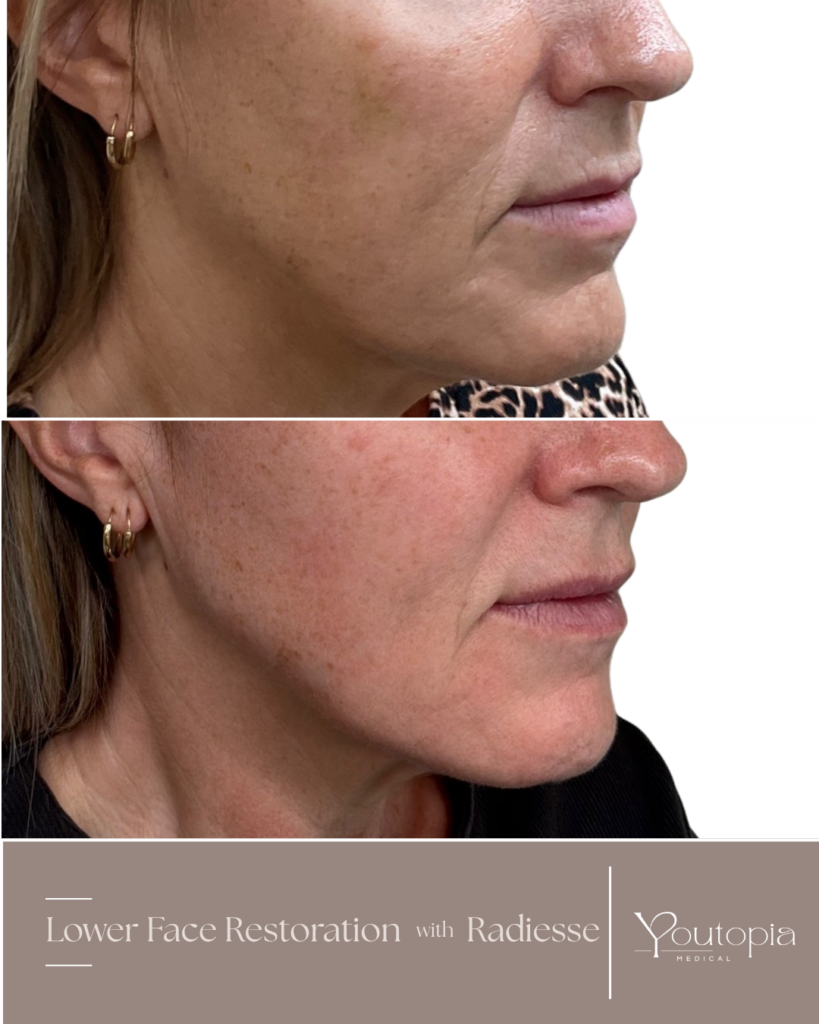
Radiesse can also be adapted depending on the concern being treated. Standard Radiesse is typically used where additional structural support is required, such as improving jawline definition or restoring facial architecture.
Radiesse Hyperdilute, available at Youtopia Medical, is prepared differently so it spreads more evenly beneath the skin. Rather than restoring volume, its primary purpose is to improve skin quality, stimulate collagen and increase firmness across larger treatment areas. It has become particularly popular for patients noticing early skin laxity of the lower face, neck and other areas where collagen decline is beginning to affect skin quality.
How Does Sculptra Work?
Sculptra is also a collagen stimulator, although it works in a different way.
It contains poly-L-lactic acid (PLLA), a biodegradable material that has long been used within medicine. Rather than providing immediate structural support, Sculptra acts primarily by stimulating the body’s collagen production over time.
Following treatment, the PLLA particles trigger a gradual regenerative response. Fibroblasts begin producing new collagen, helping restore some of the skin’s underlying support as the months progress.
Because there is no immediate structural scaffold in the same way as Radiesse, patients should not expect to leave the clinic looking dramatically different. The improvements appear gradually and often require a series of treatment sessions to achieve the desired result.
For some patients, this progressive approach is exactly what they are looking for. Others may prefer a treatment that combines collagen stimulation with earlier visible improvement. Neither approach is inherently right or wrong. It simply depends on what the individual patient hopes to achieve.
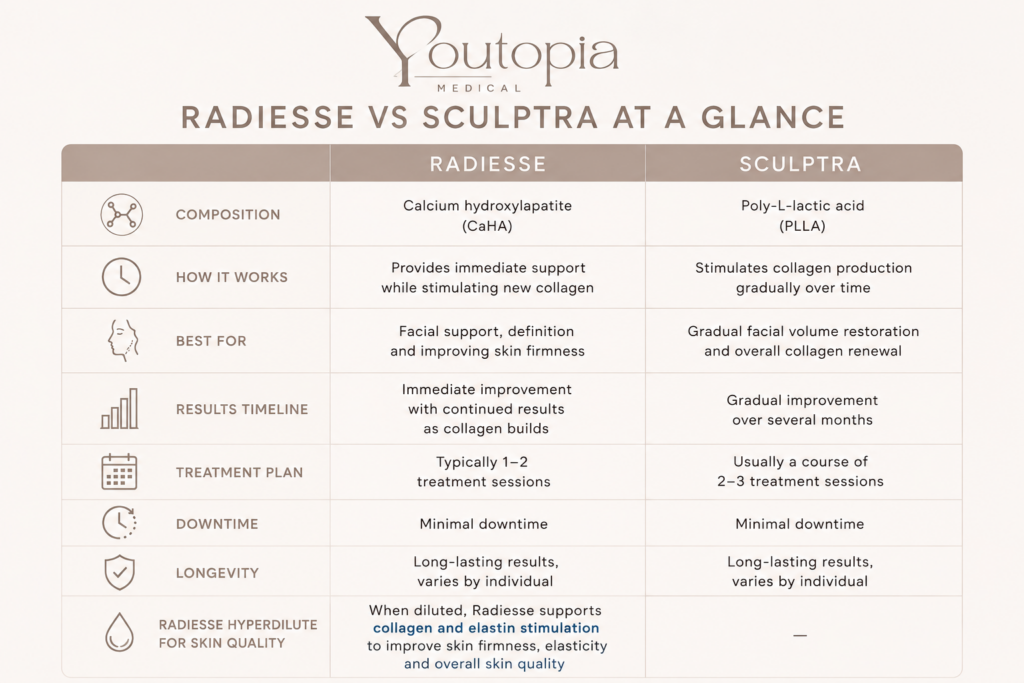
Radiesse vs Sculptra: What’s the Difference?
Although both treatments belong to the collagen stimulator family, they have several important differences that influence how they are used in clinical practice.
Which Treatment Is Better for Different Signs of Ageing?
Facial ageing is usually caused by a combination of:
- Collagen loss
- Volume loss
- Skin laxity
- Reduced skin elasticity
- Changes in facial fat and bone structure
For patients with widespread collagen loss and gradual facial hollowing, Sculptra may be an appropriate option. Results develop gradually over several months and typically require a course of treatment.
Radiesse is often preferred when patients also want to improve:
- Jawline definition
- Facial support
- Skin firmness
- Mild to moderate skin laxity
Because Radiesse provides immediate structural support while stimulating long-term collagen production, it offers greater versatility for many signs of facial ageing and can be tailored to the individual’s facial anatomy and treatment goals.
At Youtopia, we use Radiesse rather than Sculptra, but this is not about one treatment being “better” than the other. It comes down to the versatility of the product, the science behind it and how we approach each patient individually.
Radiesse gives us the flexibility to use it in different ways depending on what we are trying to achieve. Used in its standard form, it can provide structural support and improve facial contours. When diluted or hyperdiluted, the focus shifts towards stimulating collagen and elastin to improve skin quality, firmness and laxity.
Its smooth, uniform calcium hydroxylapatite (CaHA) microspheres also have a more consistent morphology than the irregularly shaped particles found in PLLA, with research suggesting differences in the inflammatory response they generate.
It is this combination of versatility, biocompatibility and controlled collagen stimulation that makes Radiesse such a valuable part of our approach to treating the different stages of facial ageing.
Can Radiesse Be Combined With Other Treatments?
One treatment alone rarely addresses every aspect of facial ageing.
Collagen decline, dehydration, volume loss, changes in facial fat, reduced elasticity and sun damage often occur together. For this reason, combination treatment plans frequently produce the most balanced results.
Following a detailed consultation, Radiesse may be incorporated into a personalised treatment plan alongside other treatments available at Youtopia Medical.
Profhilo
Although both stimulate collagen, Profhilo works very differently from Radiesse.
Profhilo focuses on improving hydration, skin quality and elasticity using stabilised hyaluronic acid, while Radiesse provides greater structural support alongside collagen stimulation. For patients with dehydrated, thinning skin, this combination can improve both skin quality and underlying support without creating an overfilled appearance.
Profhilo Structura
Ageing affects more than the skin alone. The superficial fat compartments of the face also change over time, contributing to flattening through the cheeks and reduced facial support.
Profhilo Structura has been developed to support these deeper structural changes. For suitable patients, it may complement Radiesse by addressing different tissue layers, creating a more comprehensive regenerative treatment plan.
Dermal Fillers
A common mistake patients make is assuming collagen stimulators replace dermal fillers completely. They do not. Rather, collagen stimulation improves tissue quality and support, but it cannot always restore volume where it has been significantly lost.
For patients with more advanced hollowing of the cheeks, temples or chin, carefully placed dermal fillers may still be recommended. Radiesse can then improve the quality and support of the surrounding tissues, creating a more harmonious overall result.
Secret RF Microneedling
Collagen can be stimulated in several different ways. While Radiesse encourages collagen production from within the tissues, Secret RF Microneedling uses radiofrequency energy combined with microneedling to trigger collagen remodelling within the skin itself.
For patients concerned by early skin laxity, acne scarring or changes in skin texture, combining these two approaches may provide more comprehensive skin rejuvenation than relying on either treatment alone.
Medical-Grade Skincare
Even the most advanced injectable treatment cannot replace a healthy skin barrier.
Daily medical-grade skincare helps protect collagen from ongoing environmental damage while supporting the skin’s normal repair processes. Ingredients such as antioxidants, retinoids and daily SPF all contribute to maintaining the improvements achieved through clinic treatments.
For milder cases, we would usually start with a personalised skincare programme before progressing to injectable treatments if further collagen support is required.
Considering Radiesse in Cannock?
Choosing between Radiesse and Sculptra should never be about following trends or selecting the treatment that someone else has had. The most appropriate option depends on understanding how your face has changed and which tissues are contributing to those changes.
At Youtopia Medical in Cannock, Stone and Ashbourne, every consultation begins with a detailed facial assessment rather than recommending the same treatment for every patient. By assessing skin quality, collagen loss, facial support and volume together, we can recommend the approach most likely to achieve natural-looking, long-term results.
Whether treatment involves Radiesse alone or a personalised combination with Profhilo, Profhilo Structura, dermal fillers or medical-grade skincare, our focus is always on restoring healthy facial support rather than chasing short-term trends.
Book a consultation at Youtopia Medical to discuss your concerns and receive a personalised treatment plan.